

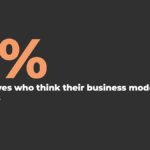




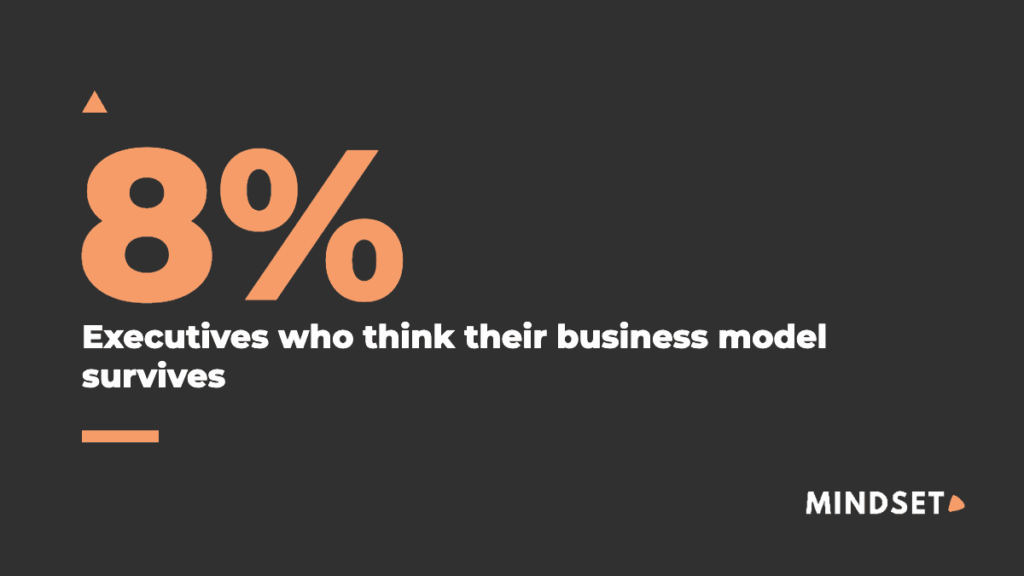
Somewhere around 2017, McKinsey sat down with more than a thousand executives and asked them a question that should have kept all of them up at night: If your industry continues to digitize at its current pace, will your business model still be economically viable?
Only 8% said yes.
Let that land for a second. Ninety-two percent of senior leaders surveyed acknowledged — on paper, to researchers — that their current way of making money would not survive the digital shift already underway. And then most of them went back to their offices and changed almost nothing.
The Knowing-Doing Gap Is Where Companies Die
Jacques Bughin, who led McKinsey’s digital research at the time, described the disconnect as “the most dangerous gap in modern business strategy.” Leaders weren’t unaware. They were paralyzed.
“The data is unambiguous,” Bughin told McKinsey Quarterly. “Executives understand the threat intellectually. What they lack is an organizational mechanism for responding to it at the speed the threat demands.”


The survey revealed that approximately 80% of executives believed their current business models were at risk due to digital advances. But when asked whether their organizations were taking adequate steps to respond, fewer than a third said yes. The gap between diagnosis and treatment was lethal.
This pattern — seeing the iceberg, acknowledging the iceberg, steering directly into the iceberg — isn’t stupidity. It’s organizational physics. Large companies are optimized to do what they already do. Every process, every incentive structure, every reporting relationship is designed to maintain the current model. McKinsey’s own analysis of why digital strategies fail pointed to this structural inertia as the primary killer.
The Three Blockers Nobody Wants to Talk About
When McKinsey dug into the specific organizational barriers preventing transformation, three kept surfacing.
The first was siloed decision-making. Digital transformation doesn’t respect org charts. It requires product, engineering, marketing, and operations to work in concert. But most companies were making digital decisions inside individual business units, with no mechanism for cross-functional coordination. The result was dozens of small digital projects that never added up to a coherent strategy.
The second was a talent gap so severe it functioned as a structural constraint. Eighty-seven percent of executives reported experiencing skill gaps in their workforce or expected them within a few years. You can’t transform a business model when the people running the current one don’t have the capabilities needed for the new one.
The third blocker was cultural resistance, and it was the most pernicious because it masqueraded as pragmatism. “We tried that and it didn’t work.” “Our customers aren’t ready for that.” “Let’s wait for the data.” These sound reasonable. They’re actually the immune response of an organization fighting to preserve itself.

If you’ve ever wondered why context switching costs teams so much, multiply that friction by an entire enterprise trying to run two business models simultaneously. The cognitive overhead alone is devastating.
The Companies That Actually Moved
Not everyone froze. McKinsey identified a cohort of “digital leaders” — roughly the top quartile of companies by digital maturity — who were capturing disproportionate value. These firms shared specific characteristics that had nothing to do with technology budgets.
They made bold resource-allocation decisions, shifting more than 50% of their capital expenditure toward digital business models even when existing models were still profitable. They restructured their leadership teams to include digital-native executives at the C-suite level. And they treated digital transformation as a strategy question, not a technology question.
Tanguy Catlin, a McKinsey senior partner who co-authored several of the firm’s digital transformation studies, noted that “the biggest predictor of transformation success wasn’t the amount of money spent on technology. It was whether the CEO personally owned the transformation agenda and whether the company was willing to cannibalize its own revenue streams.”
That last part is the hardest. Voluntarily disrupting a profitable business model requires a kind of organizational courage that most management structures actively discourage.
Seventy Percent Failure Is Not Inevitable
The broader data on transformation success rates is grim. Roughly 70% of all business transformations fail. Digital transformations fail at an even higher rate. But the framing matters. These aren’t random failures. They follow predictable patterns — patterns that McKinsey has documented extensively.
The companies that succeed share three habits. They communicate the case for change relentlessly, at every level of the organization. They invest in building new capabilities before they need them. And they measure progress with new metrics rather than trying to evaluate a new business model using the scorecard of the old one.
That communication piece is where most companies fall apart. Leaders assume that because the board has seen the strategy deck, the organization understands the transformation. It doesn’t. The research on effective feedback and behavior change shows that information doesn’t become understanding until it’s been translated into specific, personal terms for every team.
The 8% Question Still Stands
The original McKinsey survey is now several years old. The digitization it warned about has only accelerated, with AI adding an entirely new dimension to the disruption. If 92% of executives thought their business models were doomed before generative AI existed, the current number can only be worse.
The companies that took the data seriously and moved early are now the ones setting the pace. The rest are still having the same conversations, running the same pilot programs, and wondering why the gap between them and the leaders keeps growing.
Awareness was never the problem. Action was. And for most companies, it still is.