



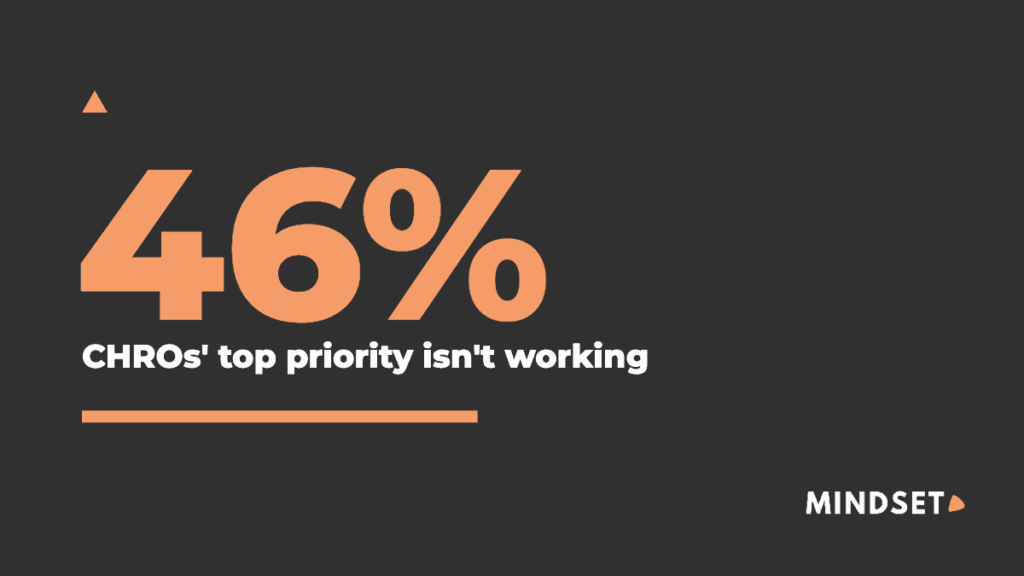
For the second consecutive year, 46% of CHROs rank leadership and manager development as their top organizational priority. That finding comes from SHRM’s 2026 CHRO Priorities and Perspectives report, which surveyed 129 senior HR leaders across 23 industries. The programs are growing. The budgets are increasing. And manager engagement just hit a 12-year low.
Something is broken in the way organizations develop managers, and the fix is not more of what we have been doing. I think the problem is structural. Most manager development programs teach the wrong skills, at the wrong time, to people who were never set up to apply what they learn.
Why the investment keeps growing while results stall
The gap between investment and outcome has a pattern. Organizations identify manager capability gaps (coaching, change management, trust-building), then design programs to address those gaps, then measure completion rates instead of behavior change. The cycle repeats annually.
Gartner’s 2026 HR priorities research tells the same story from a different angle. Leader and manager development remains CHROs’ top priority, with organizations focused on equipping managers with agility, confidence, and resilience. Those are admirable goals. They are also nearly impossible to teach in a workshop.
The typical manager development program runs for six to 12 weeks. It includes modules on feedback, communication, delegation, and strategic thinking. Participants complete the modules, rate the experience positively, and return to the same environment that created the capability gaps in the first place. Within 90 days, most of what was learned has faded.


I have watched this play out across dozens of organizations. The programs are not bad. The conditions managers return to are bad. You cannot teach someone to coach effectively and then give them 12 direct reports, three concurrent restructuring projects, and no protected time for one-on-ones.
What this means for managers and teams
If you are a manager, this data should concern you for a specific reason. Your organization is likely spending money on your development while simultaneously making it harder for you to apply what you learn. The result is a credibility gap. Leadership says development matters, but the daily reality says output matters more.
DDI’s 2026 Global Leadership Forecast found that 71% of leaders report increased stress, and 40% are considering leaving leadership roles entirely. That is not a training problem. That is a job design problem. When manager engagement is at its lowest point in over a decade, the answer is not another leadership workshop.
The managers who are thriving right now share a common trait. They have been given fewer direct reports, clearer decision authority, and realistic expectations about what they can accomplish in a quarter. Their development did not come from a program. It came from having the conditions to actually manage.
Teams feel this too. When your manager is overwhelmed and undertrained (or trained but unable to apply the training), you end up managing sideways and upward. You fill the gaps informally, without the title or the compensation.
What leaders should do now
If you are a CHRO or senior leader evaluating your manager development investment, here is a different approach than what most organizations are running.

- Cut the span of control before adding programs. No development program can compensate for a manager with 15 direct reports. Research consistently shows that managers with eight or fewer direct reports have higher engagement scores, better retention, and more time for the coaching behaviors you are trying to develop. Before you fund another cohort, fund smaller teams.
- Replace completion metrics with behavior metrics. Stop measuring how many managers finished the program. Start measuring how frequently they hold one-on-ones, how their direct reports rate feedback quality, and whether their team’s attrition rate changes within six months of program completion.
- Build development into the workflow. The most effective manager development I have seen is not a separate program. It is a structured peer group that meets biweekly, discusses real situations, and holds members accountable. This costs almost nothing compared to enterprise learning platforms, and it produces lasting behavior change because the learning is embedded in the work.
- Protect development time in the calendar. If your managers cannot block four hours per week for development activities (including one-on-ones, peer learning, and reflection), your job design is the problem. Fix the calendar before you fix the curriculum.
- Stop developing managers who should not be managers. Some of your best individual contributors were promoted into management because it was the only path to higher compensation. Give them a technical track instead. Fewer, better managers will outperform a larger group of reluctant ones every time.
If your leadership pipeline already shows signs of weakness, you need a development system that operates outside of HR’s annual cycle and lives closer to where actual management happens.
Broader context and what to watch
The fact that CHROs have named the same priority two years in a row without measurable improvement should prompt a more honest conversation. Either the problem is harder than the industry acknowledges, or the standard approach to solving it is wrong. I believe it is both.
Manager development is being asked to solve problems that are actually created by organizational design. Span of control that is too wide, decision authority that is too narrow, meeting loads that are too heavy, and performance expectations that assume managers have no development responsibilities at all. No program can overcome those structural barriers.
Watch for a shift in how organizations measure manager effectiveness over the next 12 months. The leading companies are moving away from 360-degree surveys and toward operational metrics like team retention, time-to-productivity for new hires, and internal mobility rates. These metrics are harder to game and more directly connected to what good management actually produces.
The 46% figure will probably climb again next year. The question is whether the conversation changes from “we need more manager development” to “we need to make management a job people can actually do well.” Until that shift happens, the investment will keep growing and the results will keep disappointing.