



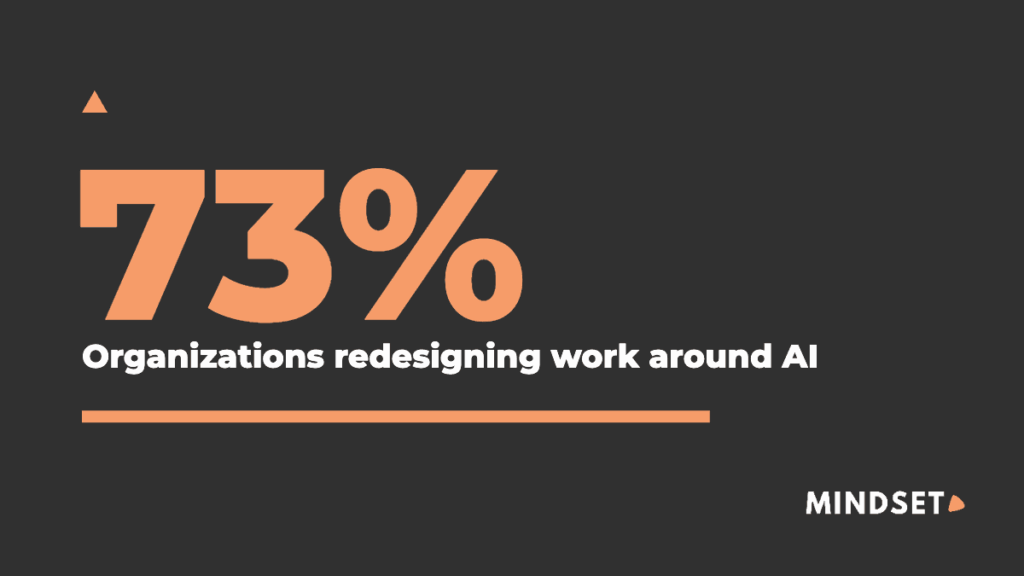
When Deloitte released its 2026 Global Human Capital Trends report this spring, one number jumped off the page: nearly 60% of workers now use AI intentionally at work. But here’s the number that should worry you more — only 6% of leaders say they’re making progress in actually designing how humans and AI should work together.
That’s a gap wide enough to swallow entire organizations. Workers are already using the tools. Leadership is still drawing diagrams on whiteboards about whether to use the tools. And in the middle, a massive communication vacuum where nobody is telling the people doing the actual work what the plan is.
The Survey Behind the Data
Deloitte partnered with Oxford Economics to survey more than 9,000 business and human resources leaders across 89 countries. But they didn’t stop there. They ran supplemental surveys of workers, managers, and executives separately — specifically to identify where perceptions diverged.
The divergence was enormous.
Forty-two percent of workers said their organizations weren’t evaluating AI’s impact on people at all. Not poorly. Not insufficiently. Not at all. Meanwhile, leadership teams were actively redesigning roles, workflows, and organizational structures around AI capabilities. They just weren’t telling anyone.


Steve Hatfield, Deloitte’s global leader for the Future of Work, framed the disconnect plainly: “Organizations are making consequential decisions about how work will be structured in the AI era, but they’re doing it in a way that’s invisible to the people most affected.”
The Three Practices That Separate the Winners
Not every organization in the survey was fumbling. Deloitte identified a subset of companies handling the AI transition measurably better than their peers. They shared three specific practices.
First, they designed AI interactions for both business and human outcomes. Only 40% of organizations in the survey did this. The majority — 56% — designed AI implementations solely around business metrics like efficiency, speed, or cost reduction. The companies that considered human outcomes — worker satisfaction, skill development, role clarity — saw significantly better adoption rates and lower resistance.
Second, they invested in what Deloitte called “human-AI interaction design.” This sounds like a buzzword, but the concept is straightforward: before deploying an AI tool, these companies mapped out exactly which decisions the AI would make, which decisions humans would make, and which would require collaboration. They made the invisible visible.
Third — and this is the one most companies skip — they communicated relentlessly. Not once. Not in a town hall. Continuously, at every level, through managers who were trained to translate organizational strategy into team-level implications. The research on effective managerial communication consistently shows that information only becomes understanding when it’s made personal and specific.
Why the Communication Gap Is So Dangerous
The Deloitte data revealed that one-third of workers experienced 15 or more major organizational changes in the past year alone. Fifteen. And only 27% of respondents believed their organizations managed change effectively.

Erica Volini, a senior leader in Deloitte’s Human Capital practice, described the compounding effect: “When you layer AI transformation on top of an already exhausting pace of change, without clear communication about what’s happening and why, you don’t get resistance. You get resignation. People stop engaging with change because they’ve learned that nobody’s going to explain it to them anyway.”
That’s the real risk. Not active rebellion, but passive withdrawal. Workers who nod along in meetings, complete the mandatory training, and then quietly disengage from an organization they no longer trust to be honest with them.
The connection to declining manager engagement is direct. Managers are the translation layer between executive strategy and worker reality. When they’re disengaged — and the data says they increasingly are — the communication channel between leadership and frontline workers effectively goes dead.
The Accountability Problem Nobody Wants to Own
Perhaps the most revealing finding in the Deloitte survey was this: 60% of executives now use AI in decision-making, but only 5% say they manage it well. Five percent.
That means 95% of executives who are using AI to make decisions — about hiring, resource allocation, strategy, performance evaluation — acknowledge that they lack adequate governance around those decisions. They’re using the tools without the guardrails. And they’re not building the guardrails because nobody is sure who’s responsible for them.
“Accountability is the missing piece,” Hatfield said. “Who is responsible when an AI-assisted decision goes wrong? In most organizations, the answer is nobody, which means the worker bears the consequence without recourse.”
The Deloitte report found that only 8% of organizations rated their change management efforts as highly effective. That number, in a year when AI is reshaping work at unprecedented speed, is a quiet crisis.
What Actually Needs to Happen
The organizations succeeding at this transition aren’t the ones with the biggest AI budgets or the most sophisticated tools. They’re the ones that treat the human side of the AI transition with the same rigor they apply to the technical side.
They map roles. They communicate decisions. They train managers to have honest conversations about what’s changing and what isn’t. They create feedback loops so workers can surface problems before those problems become crises.
The Deloitte data suggests that most organizations are doing none of this. They’re redesigning work in conference rooms and deploying AI in dashboards and assuming that the people doing the work will figure it out on their own.
Workers aren’t stupid. They can feel the ground shifting. The question isn’t whether they’ll adapt — the 60% already using AI prove they will. The question is whether they’ll adapt with their organization or despite it. And right now, the data says most of them are on their own.