



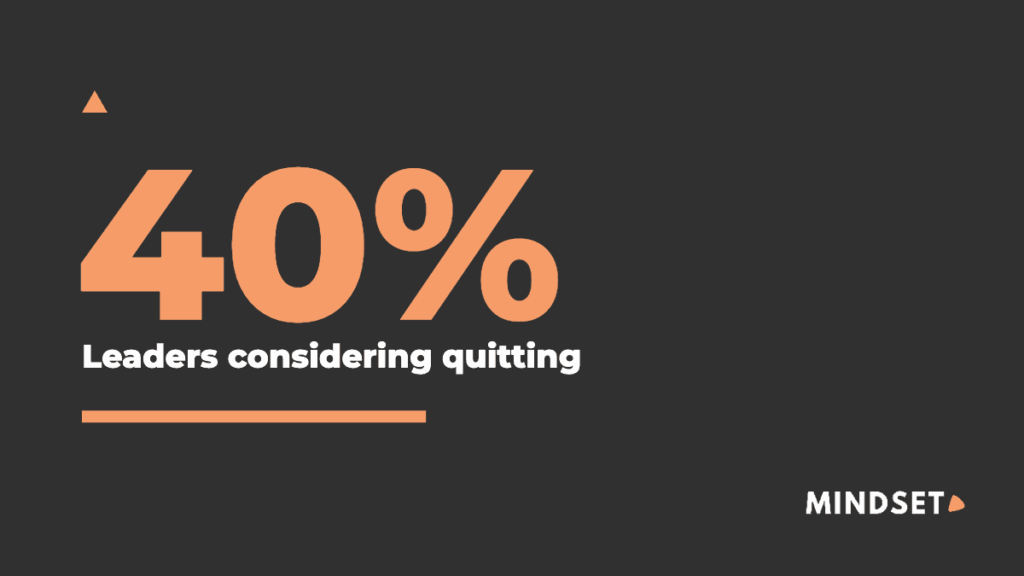
DDI’s 2026 Global Leadership Forecast found that 71% of leaders report increased stress compared to a year ago. Of those stressed leaders, 40% are considering leaving leadership roles entirely to protect their well-being. At the same time, 77% of CHROs say they lack confidence in their bench strength for filling the most important leadership roles. This is a compounding crisis: the people in leadership are burning out while the pipeline to replace them sits nearly empty.
Leadership attrition at this scale is not a human resources problem. It is a business continuity problem. And the standard response (more resilience training, better benefits, a wellness app) misses the point entirely. The job itself has become unsustainable for most of the people doing it.
What DDI’s data actually reveals about leadership stress
The 71% figure covers leaders across all levels, but the stress is not distributed evenly. First-time managers and mid-level leaders report the sharpest increases. These are the people caught between executive mandates and frontline reality, expected to drive results while also absorbing the emotional load of their teams.
DDI identifies several compounding factors. Market volatility, restructuring fatigue, and AI-driven transformation demands have all landed on leaders simultaneously. None of these pressures is new individually. But the combination creates what DDI calls “quiet cracking,” where leaders stay in their roles but fracture internally. They meet their targets. They attend the meetings. But they have stopped investing discretionary effort in the people, culture, and long-term work that makes leadership valuable.
I think “quiet cracking” is actually a more accurate description than burnout for what is happening. Burnout implies a breaking point, a moment when someone stops functioning. Quiet cracking is slower and harder to detect. The leader is still performing. They have just stopped caring about anything beyond survival.

The 80% of organizations that lack confidence in their leadership bench are dealing with two forces at once. Experienced leaders are pulling back or leaving. And the next generation of potential leaders is watching and deciding they want no part of it.
What this means for managers and teams
If you report to a leader who seems checked out, detached, or suddenly less invested in your development, you may be seeing quiet cracking in real time. This is not a personality issue. It is a systemic one. And it directly affects your own career trajectory.
When your leader lacks the bandwidth to sponsor your growth, advocate for your promotion, or shield your team from organizational noise, you end up managing around them. The work still gets done, but the leadership layer that is supposed to clear the path for you has become an obstacle instead.
For managers reading this who recognize themselves in the 40%, I want to be direct. Considering an exit is rational when the job has been designed to be unsustainable. But before you leave, consider whether the stress is coming from the role itself or from the specific conditions of your current organization. Sometimes the fix is a redesigned role, not a career change. If your organization’s leadership pipeline is already showing weakness, you may have leverage to negotiate better conditions.
Teams should also recognize that leadership attrition creates opportunity. When senior leaders leave, the organizations that have built internal capability will promote from within. The ones that have not will scramble to hire externally at a premium. Either way, the disruption is coming. Your job is to be ready for it.
What leaders should do now
If you are a senior leader or CHRO looking at these numbers, the instinct is to launch a retention program. That instinct is incomplete. You need to redesign the leadership role itself.


- Audit the leadership load. Take your average mid-level leadership role and list every expectation attached to it: people management, strategic planning, cross-functional projects, reporting, compliance, AI adoption, culture building, and whatever else has been layered on. If the list exceeds what one person can reasonably accomplish in a 50-hour week, start removing items. You will find that at least 20% of the load is organizational theater that does not produce results.
- Separate people leadership from project leadership. Many leaders are simultaneously managing a team and running one or more major initiatives. These are two full-time jobs packaged as one. Split them where possible. Dedicated people leaders with reasonable spans of control will outperform dual-role leaders every time.
- Create off-ramps that are not exits. Some leaders need a break from management, not a career change. Build rotation programs that allow leaders to step into individual contributor roles for six to 12 months without losing seniority or compensation. This is cheaper than replacing them, and many will return to leadership refreshed.
- Fix the meeting tax. Leaders consistently report that meetings consume 60% or more of their working hours. Every meeting on a leader’s calendar that does not require their specific judgment or authority is a meeting that should be eliminated or delegated. Conduct a calendar audit and cut aggressively.
- Invest in the bench now, not after people leave. The 77% of CHROs who lack confidence in their bench strength are describing a problem that takes 18 to 24 months to fix. If you have not started building your manager development system, you are already behind. Every month of delay increases the cost and risk of leadership attrition.
Broader context and what to watch
The leadership attrition trend intersects with several other workforce shifts happening in 2026. The “job hugging” phenomenon, where leaders stay in roles to avoid an uncertain job market, is temporarily masking the true attrition intent. When the market stabilizes, expect a delayed wave of leadership departures that catches unprepared organizations off guard.
DDI also notes that fewer leaders are moving into new roles across the board, which is slowing development and reducing the experiential learning that builds leadership capability. It is a vicious cycle. Stress prevents mobility, lack of mobility prevents development, underdeveloped leaders experience more stress.
The organizations worth watching are the ones redesigning the leadership role rather than just supporting the people in it. Smaller spans of control, clearer decision authority, protected time for strategic work, and realistic expectations about what one person can accomplish. These are structural changes, not program changes.
The 40% number will likely grow before it shrinks. The question for every organization is whether they will lose their leaders to attrition or lose them to quiet cracking. Both outcomes are damaging. Only one is visible enough to trigger a response. The smart organizations are not waiting for resignations. They are redesigning the job today.