






Do you have a growth mindset? Take our free quiz.
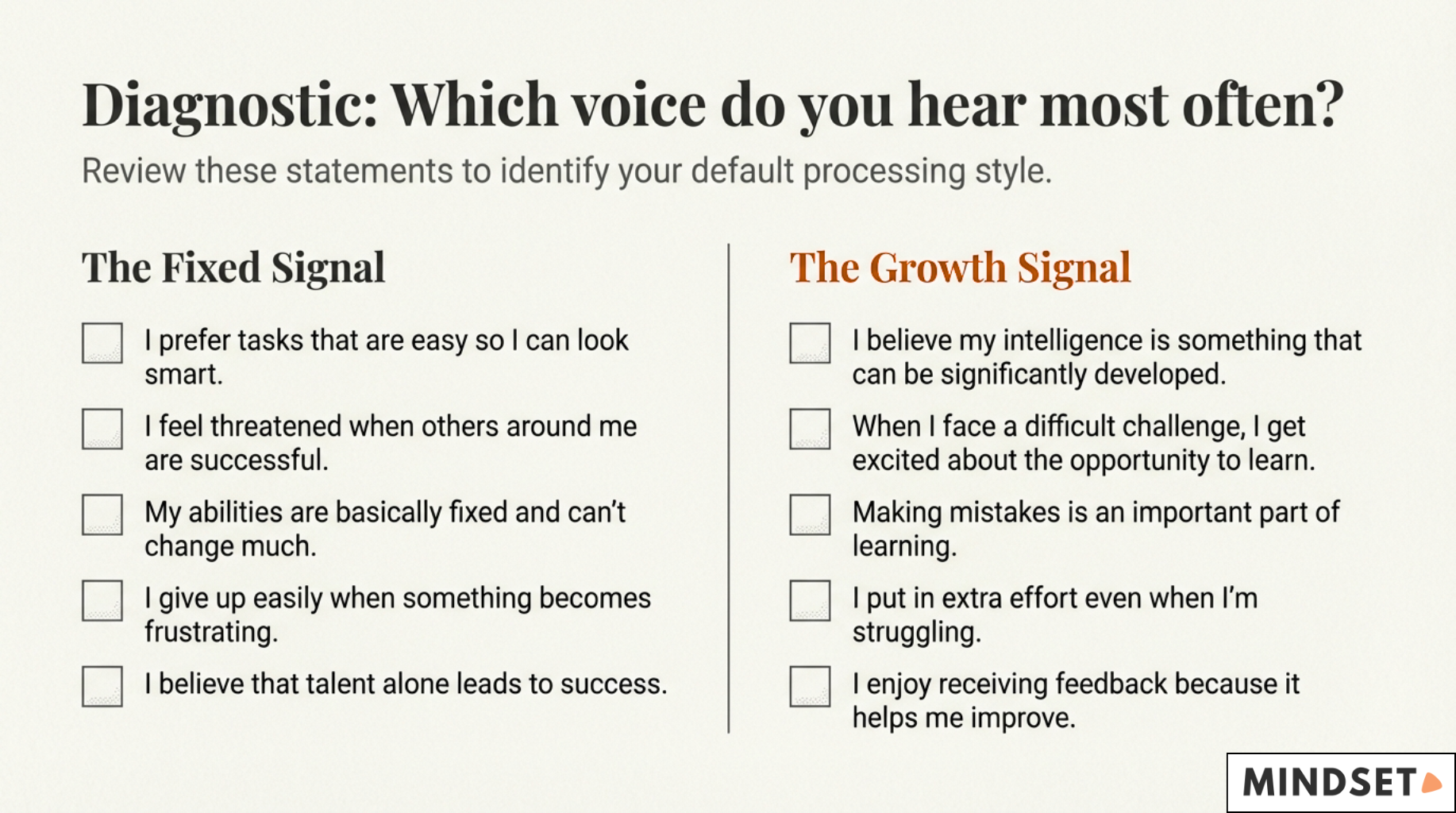
I believe my intelligence is something that can be significantly developed.
When I face a difficult challenge, I get excited about the opportunity to learn.
I prefer tasks that are easy so I can look smart.
Making mistakes is an important part of learning.
I feel threatened when others around me are successful.
I put in extra effort even when I'm struggling with something.
My ability are basically fixed and can't change much.
I enjoy receiving feedback because it helps me improve.
I give up easily when something becomes frustrating
I believe that talent alone leads to success.


The study that started a worldwide conversation
In 1998, psychologists Claudia Mueller and Carol Dweck at Columbia University ran six experiments with 128 fifth-graders that produced a finding most parents and managers still get wrong. Each child completed a set of moderately difficult problems from the Raven’s Progressive Matrices, a standard nonverbal reasoning test. Every child was told they scored well. Then came the twist: one group heard “You must be smart at these problems.” The other heard “You must have worked hard at these problems.”
That single sentence changed everything that followed. Children praised for intelligence chose easier problems next, enjoyed the task less, performed worse after encountering difficulty, and were more likely to attribute failure to a lack of ability. Children praised for effort chose harder problems, persisted longer, and recovered their performance after setbacks. The difference was not personality. It was framing.

This study became the empirical foundation for what Dweck would later call growth mindset: the belief that abilities can be developed through effort, effective strategies, and feedback. The contrasting belief, that talent and intelligence are largely fixed, she called fixed mindset. The terms entered mainstream vocabulary in 2006 with the publication of her book Mindset: The New Psychology of Success, and they have since shaped corporate training, education policy, and parenting advice worldwide.
I think the Mueller and Dweck findings hold up as one of the most practically useful discoveries in modern psychology. But the concept has also been oversimplified, overapplied, and in some cases, weaponized in ways that Dweck herself has pushed back on. Understanding what the research actually shows, where it breaks down, and where legitimate criticism exists is what separates useful application from motivational poster thinking.
You may also Like


What growth mindset actually means, and what it does not
A growth mindset, in Dweck’s framework, is not optimism. It is a specific belief about the nature of ability: that intelligence, skill, and competence are malleable rather than fixed. This belief changes behavior in measurable ways. People who hold it tend to seek feedback earlier, persist through difficulty longer, and treat failure as information rather than identity.
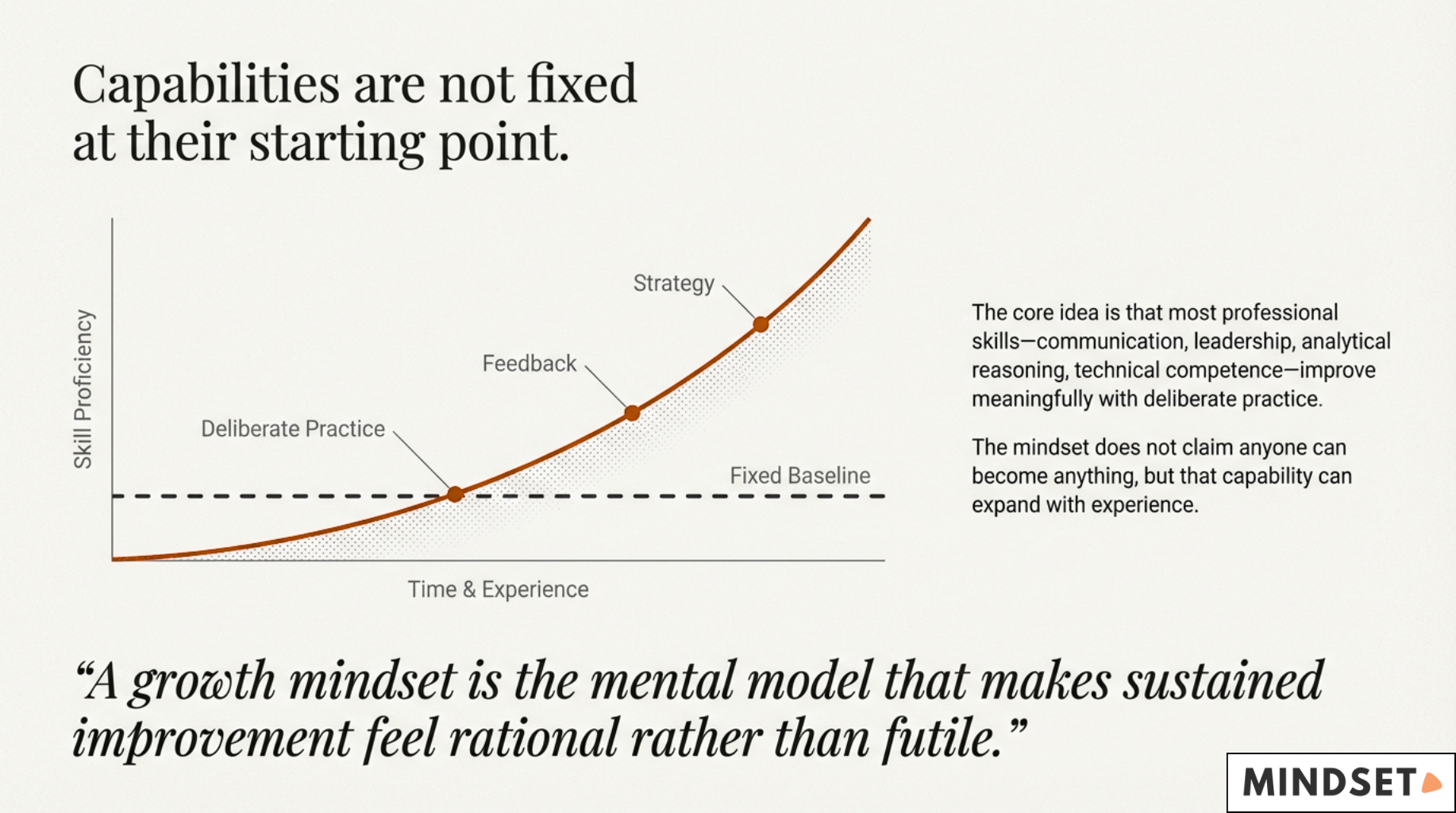
The concept is frequently distorted in practice. Dweck addressed this directly in a 2015 Education Week essay, calling out what she termed “false growth mindset,” where the label is applied without the underlying behavioral change. Here is what growth mindset is not:
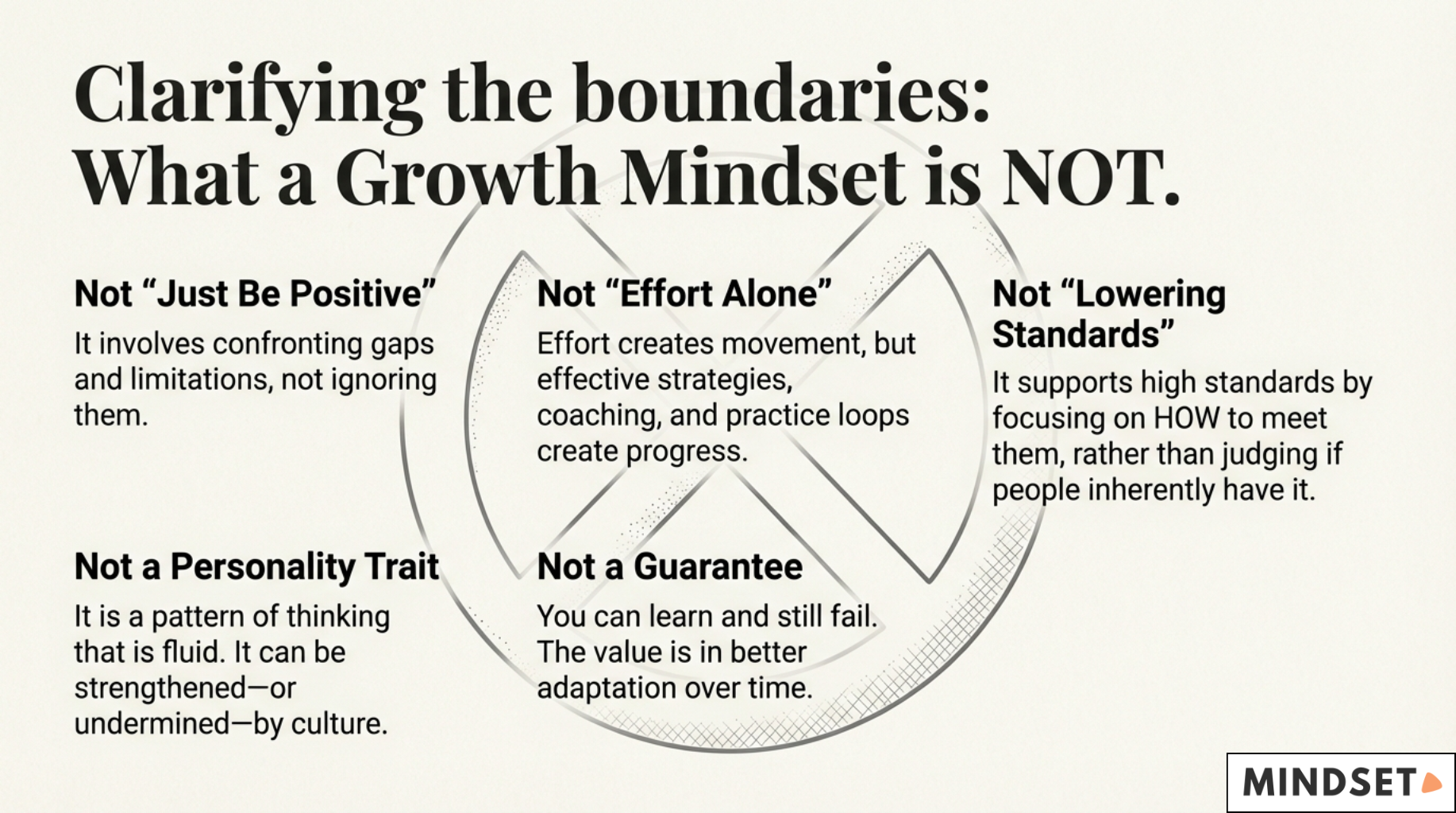
“Just be positive.” Growth mindset requires confronting gaps honestly. It is the opposite of ignoring limitations.
“Effort is enough.” This is the misapplication Dweck has been most vocal about correcting. Effort without effective strategy, coaching, or feedback is just spinning. Praising pure effort when results are poor can be as damaging as praising talent.
“Anyone can become anything.” Growth mindset claims that capability is not fixed at its starting point. It does not claim that starting points, access to resources, and structural constraints are irrelevant.
You may also Like


“A personality trait.” Mindset is contextual. Most people hold growth beliefs in some domains and fixed beliefs in others. A manager might believe leadership skill is developable while believing public speaking ability is innate. The same person can shift between mindsets depending on stress, stakes, and identity threat.

What the largest studies found, and where the evidence gets complicated
The biggest test of growth mindset interventions came in 2019, when Yeager and colleagues published a study in Nature involving over 12,000 ninth-graders across 76 nationally representative U.S. public high schools. The intervention was brief: less than an hour of online material teaching students that intellectual abilities can be developed. The result was a 0.10-point improvement on a 4.0 GPA scale among lower-achieving students, with increased enrollment in advanced math courses.
That finding is real, but it needs context. A 0.10 GPA improvement from a sub-one-hour intervention is meaningful at population scale, but it is not the transformative academic turnaround that popular accounts often suggest. The study also found that the intervention only worked in schools where peer norms supported growth-oriented behavior. In schools where the dominant culture rewarded looking smart over learning, the intervention had no measurable effect. Environment mediates mindset. The belief alone is not enough.
I think the Nature study is the most important finding for managers and leaders to understand, because it mirrors what happens in organizations: you can train individuals in growth mindset thinking, but if the team culture punishes mistakes and rewards looking competent over getting better, the training will produce nothing.
The broader meta-analytic picture is more modest than early enthusiasts suggested. Multiple meta-analyses have found that growth mindset interventions produce small effects on academic achievement, and that simply holding a growth mindset, without structural support and behavioral change, does not reliably predict better outcomes. A 2024 review in Frontiers in Psychology confirmed that while mindset interventions can successfully change a person’s stated beliefs about intelligence, this belief shift alone has limited effect on actual performance without corresponding environmental support.
How mindset shows up at work
The academic debate is about effect sizes in controlled studies. The practical question for managers is different: does the underlying mechanism, the relationship between beliefs about ability and responses to difficulty, show up in how people work? I think it clearly does, even if the effect is more contextual and less universal than the popular narrative suggests.
When facing a stretch assignment:
- Fixed mindset response: “I’m not good at this. If I struggle, I’ll look incompetent.”
- Growth mindset response: “I’m not good at this yet. I can get better with the right approach.”
When receiving tough feedback:
- Fixed mindset response: “This is a judgment of my capability.”
- Growth mindset response: “This is information I can use.”
When a project fails:
- Fixed mindset response: “We failed. We’re not cut out for this.”
- Growth mindset response: “We failed. What specifically can we change next iteration?”
These are not rigid personality types. Most people shift between mindsets depending on context, domain, and stress level. The practical value is in noticing which response pattern is active and whether the environment is reinforcing one over the other.
Want to go deeper? Read our full comparison: Fixed vs. growth mindset: how to grow as a person.
What leaders actually control
The Yeager Nature study’s most important finding for organizations is that mindset interventions only work when the surrounding culture supports them. Leaders have more influence over culture than they do over individual psychology. Here are the levers that the research suggests matter most.
1) How you praise shapes what people optimize for
Mueller and Dweck’s original finding translates directly to management. When you tell someone “You’re a natural at this,” you are inadvertently framing ability as a trait. When you say “Your analysis improved because you tested three different approaches before committing to one,” you are reinforcing that outcomes come from behaviors the person can repeat and refine.

This is one of the most well-supported findings in the growth mindset literature and one of the easiest to implement. The key is specificity: vague effort praise (“Great job working hard!”) is almost as unhelpful as talent praise. Useful process praise names the specific strategy, decision, or behavior that produced the result.
2) Distinguish learning mistakes from negligence
Growth mindset cultures need a clear line between two types of errors. Learning mistakes are reasonable experiments, calculated risks, and attempts at unfamiliar work that produce insight even when they fail. Negligence is avoidable error caused by ignoring known standards, skipping steps, or failing to apply existing knowledge.

Teams take productive risks only when they trust that leadership understands this distinction. If every mistake is punished the same way, the rational response is to avoid mistakes entirely, which means avoiding anything new, difficult, or uncertain. That is a fixed mindset environment by design, regardless of what the training materials say.
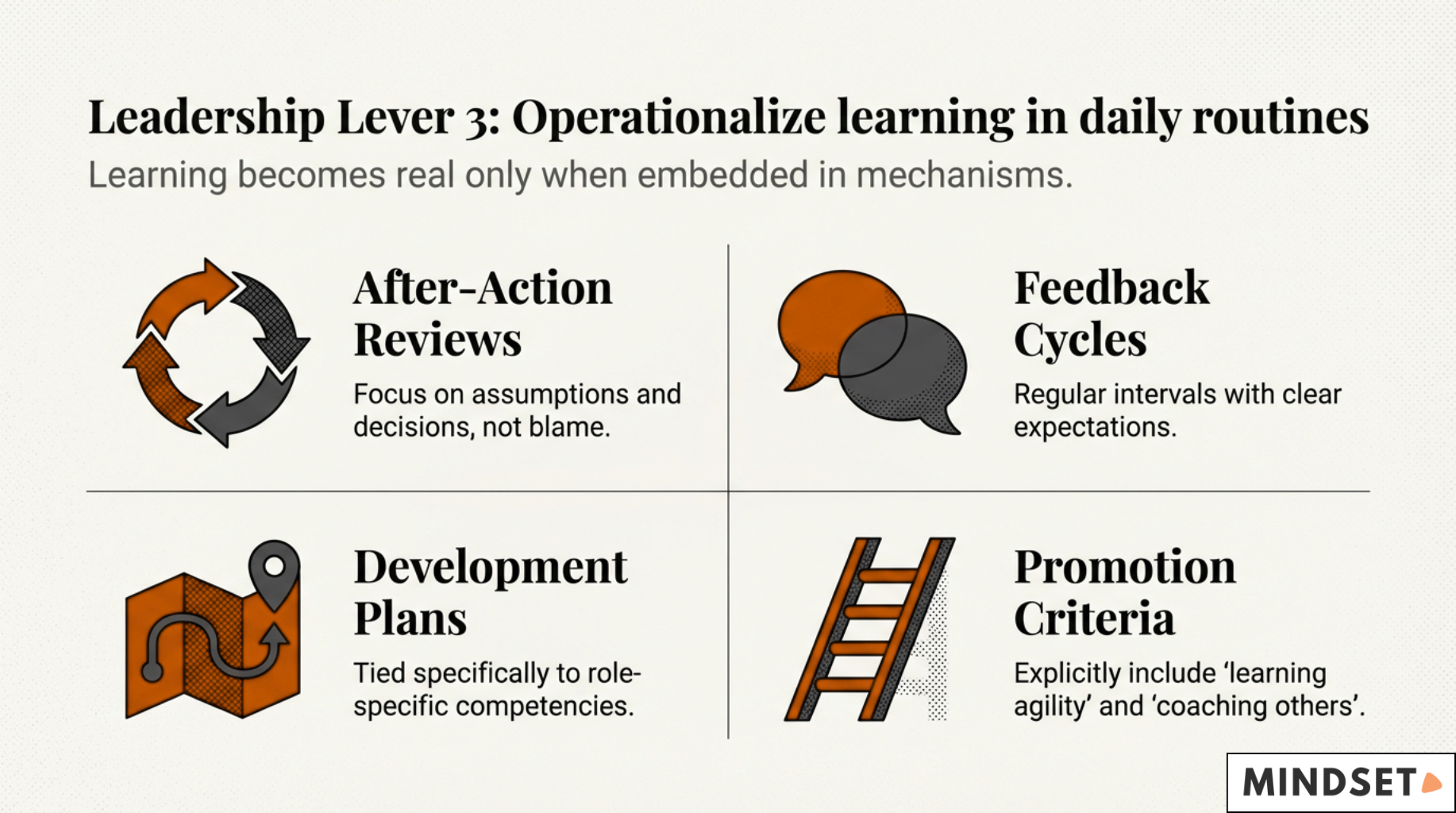
3) Embed learning in operational routines
Mindset is not sustained by workshops. It is sustained by recurring mechanisms that make learning behavior normal:
- After-action reviews focused on assumptions and decisions, not blame attribution.
- Regular feedback cycles with specific, behavioral expectations.
- Development plans connected to role-specific competencies rather than generic goals.
- Promotion criteria that weight learning agility and coaching ability alongside results.
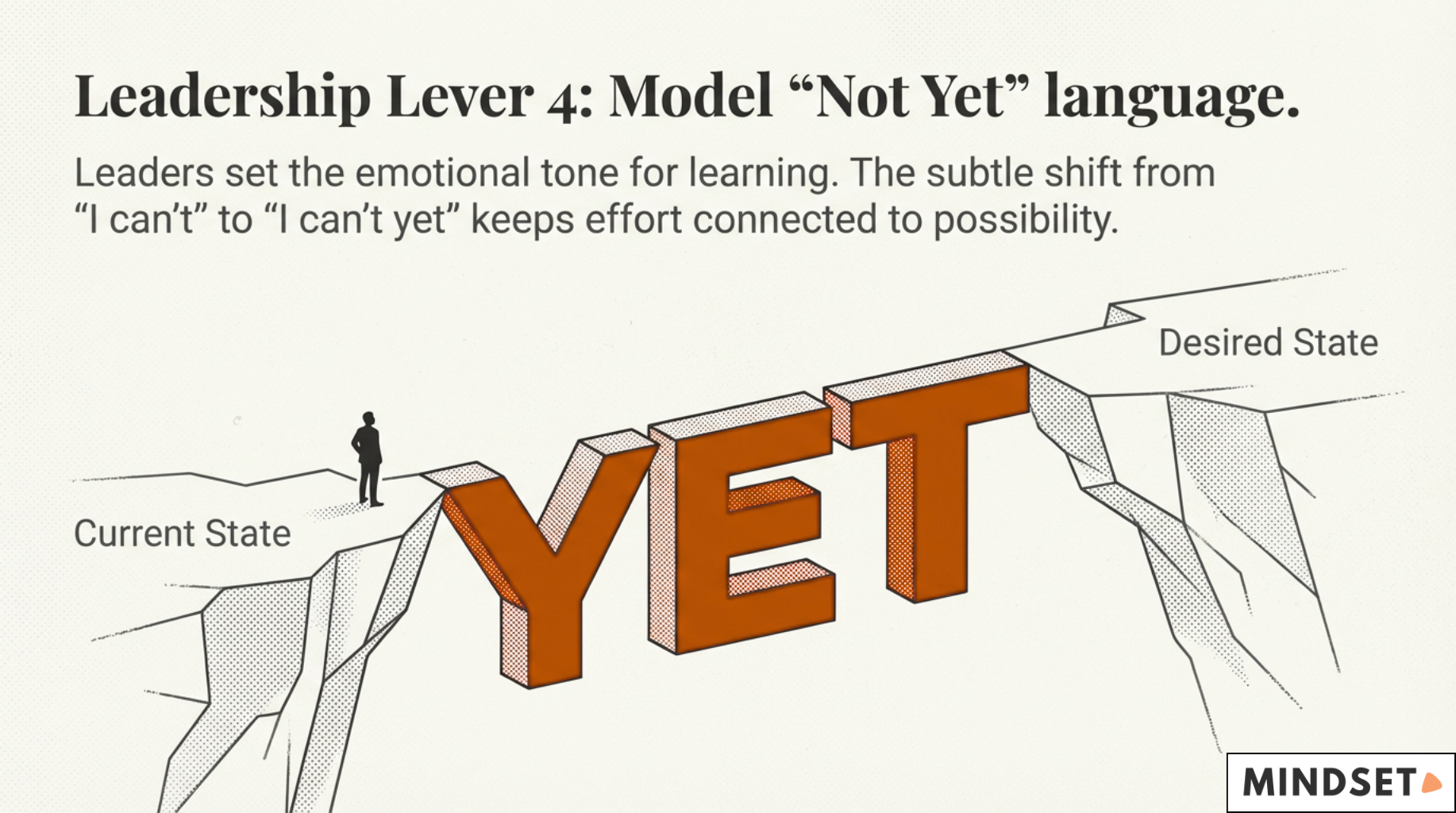
4) Model the language of “not yet”
Leaders set the emotional tone for how teams relate to difficulty. The shift from “I can’t do this” to “I can’t do this yet” is small linguistically and significant psychologically. It keeps effort connected to possibility without denying that the current gap is real.
The honest limitations of growth mindset research
Any serious treatment of growth mindset in 2026 needs to address what the research does and does not support. Ignoring the criticism does not strengthen the case; engaging with it honestly is what separates authoritative content from motivational recycling.
Several independent replication studies have found little or no support for the most dramatic claims of early growth mindset research. A well-publicized attempt to replicate two of Dweck’s most-cited papers reported minimal evidence that growth mindsets improved children’s responses to failure or school attainment. Meta-analyses have consistently shown that the effects, while real, are smaller than initial studies suggested.
A 2025 academic paper identified what the researchers call the “Growth Mindset Paradox”: a framework designed to liberate learners from fixed thinking can itself become a form of cognitive entrapment. People feel guilty for having fixed-mindset thoughts, which creates a new kind of rigidity.
Dweck herself has acknowledged many of these concerns. She has emphasized that one-time interventions, posters, or lectures defining the two mindsets are unlikely to produce lasting change. The mechanism requires ongoing environmental support, which is exactly what Yeager’s Nature study confirmed.
I think the most accurate reading of the evidence is this: growth mindset is a real psychological variable that influences behavior in specific, measurable ways. It is most powerful as a design principle for teams and cultures, where leaders can shape the environment that reinforces growth-oriented responses. It is least powerful as an individual self-help tool applied in isolation. The popular version oversells the individual effect and undersells the environmental one.

The bottom line

Growth mindset, properly understood, is a learning-first view of capability backed by decades of research and tempered by legitimate methodological debate. The Mueller and Dweck praise studies remain some of the most practically applicable findings in psychology. The Yeager Nature study confirms that mindset interventions work, but only when the surrounding environment supports them. And the honest meta-analytic picture shows modest effects that depend heavily on context.
For managers and leaders, the takeaway is straightforward: you cannot install a growth mindset in your team through training alone. You build an environment where growth-oriented behavior is the rational choice, by praising specific strategies over innate talent, distinguishing learning mistakes from negligence, embedding feedback in operational routines, and modeling the language of “not yet.” The research supports doing all of those things. It does not support expecting a poster on the wall to do them for you.
Related Mindset Quizzes
- What is a Grit Mindset?
- What is a Learning Mindset?
- What is an Experiment Mindset?
- What is an Agile Mindset?
- What is a Success Mindset?
Browse all 34 free mindset quizzes, each with a two-minute test and no signup.